
Before you spend a single dirham on acne marks treatment, one question decides everything: is that spot on your face a mark, or a scar? The two look similar in a bathroom mirror, but they are completely different things under the skin — and they respond to completely different solutions. Get this wrong and you can spend a year rubbing serums into something no serum can change. Get it right and you save money, time and a lot of frustration. This guide shows you how to tell them apart in seconds, then what actually helps each one.
The short answer
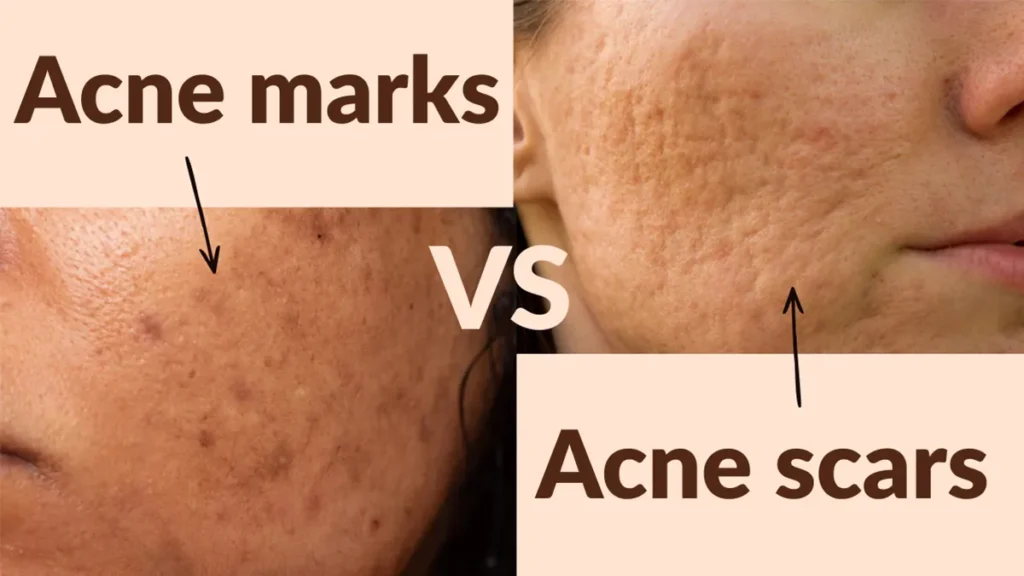
An acne mark is a change in colour: a flat red, pink or brown patch left behind after a pimple heals. An acne scar is a change in texture: a dip, pit or raised bump you can feel with a fingertip. Marks fade — on their own with time, and faster with the right skincare and daily sunscreen. True scars are structural, so no cream can fill or flatten them; they respond to professional procedures instead. That one distinction tells you whether your money belongs in a serum bottle or a dermatologist’s chair.
What acne marks actually are
When a pimple flares, your skin mounts a small emergency response. Once the breakout settles, that response can leave two kinds of leftover colour — and both are marks, not scars, because the skin surface underneath is smooth and fully healed.
Red or pink marks (post-inflammatory erythema)
These are tiny blood vessels that widened during the breakout and haven’t returned to normal yet. They show up most on fair and light-medium skin, and they blanch — press one gently and it briefly pales, then the colour floods back. Red marks usually clear over several weeks to a few months as the vessels calm down.
Brown or tan marks (post-inflammatory hyperpigmentation)
Here the skin produced extra melanin as part of its defence, and the pigment stayed after the pimple left. Brown post acne marks are especially common in medium, olive and deeper skin tones — which covers most of us in the Gulf — because melanin-rich skin responds to any inflammation by making more pigment. Left alone, these can linger from three months to a year, and every unprotected hour in strong UAE sun tops the pigment back up. If brown spots are your main concern, our dark spots guide goes deeper on this type of pigmentation.
What acne scars actually are
A scar forms when a breakout ran deep enough to damage the collagen framework that holds skin smooth. As the skin rebuilt itself, it either produced too little collagen — leaving an indent — or too much, leaving a raised bump. Dermatologists group the indented type into three shapes: ice-pick scars (narrow and deep, like a pinpoint), boxcar scars (wider depressions with defined edges) and rolling scars (soft, wave-like dips that cast shadows in side light). Raised scars, called hypertrophic or keloid, are firm bumps that sit above the surface, most often along the jaw, shoulders or chest.
Here is the part most skincare marketing skips: once the collagen structure has changed, a cosmetic product cannot rebuild it. Not ours, not anyone’s. Skincare can improve the colour and overall polish of scarred skin, which often makes texture read as less noticeable — but the dip or bump itself is a job for a clinic.
The 10-second mirror test
Feel it. Close your eyes and run a clean fingertip over the spot. Perfectly smooth means mark. Any dip, pit or bump means scar.
Stretch it. Gently pull the skin taut between two fingers. A shallow scar’s shadow softens or disappears when stretched, because you’ve flattened the dip. A mark’s colour stays exactly as it was.
Look at the colour. Red, pink or brown and flat points to a mark. A skin-coloured dent points to a scar. And if a spot is both brown and indented, you’re looking at a scar with pigment sitting on top — which is very common, and means both approaches below apply to you.
Acne marks treatment at home: what genuinely works
Because marks are pigment and redness rather than damage, home care has a real, evidence-backed role here. Four things move the needle:
Brightening actives, used daily
Ingredients like niacinamide, alpha arbutin and vitamin C work on the pigment pathway itself — slowing how much melanin is made and how it spreads into surface cells — so brown marks gradually look lighter and skin tone more even. A leave-on formula matters more than an expensive one, because these ingredients need daily contact time. Our Dark Spot Correcting Serum pairs niacinamide with alpha arbutin in one light layer designed for exactly this job.
Gentle, occasional exfoliation
Pigmented surface cells shed a little faster with mild exfoliation, which supports the fading process. Once or twice a week is plenty — scrubbing a mark daily irritates it, and irritation is precisely what created the pigment in the first place. If you are still getting breakouts, our Salicylic Acid Face Mask (2% BHA) exfoliates gently inside the pores. For a brightening boost without the friction of a scrub, a 15-minute session with our Turmeric Face Mask Sheet brings niacinamide, alpha arbutin and tranexamic acid to the skin in one step.
Sunscreen, every single morning
This is the step that decides whether everything above works. UV light instructs your skin to produce pigment, so a mark you expose to Gulf sunshine keeps getting re-darkened faster than any serum can fade it. Broad-spectrum SPF 30 or higher, reapplied when you’re outdoors, is non-negotiable — and note that none of our products contains SPF, so this is a separate bottle in your routine.
Hands off
One honest extra: squeezing or picking a healing spot pushes inflammation deeper, and deeper inflammation leaves a darker, longer-lasting mark. The less a breakout is handled, the less it leaves behind.
What to expect: with daily actives plus sunscreen, most people notice marks looking softer within four to eight weeks, with continued fading over the months that follow. Red marks generally clear before brown ones. Nothing legitimate erases a mark in days — a promise like that is your cue to close the tab.
When it’s a scar: clinic options that actually help
True texture change responds to procedures that remodel collagen or physically release the scar. The ones dermatologists reach for most:
- Microneedling — fine needles trigger fresh collagen production; usually done as a course of sessions. Often the starting point for rolling and shallow boxcar scars.
- Fractional laser resurfacing — targeted light energy stimulates deeper remodelling; effective for more established texture, with some downtime.
- Professional-strength chemical peels — far stronger than anything sold for home use; improve shallow scarring and stubborn pigment together.
- Subcision — a small needle releases the fibrous bands pulling a rolling scar downward, letting the surface lift.
- Dermal fillers — lift soft, isolated dips quickly; results are temporary but immediate.
- Steroid injections — the usual route for flattening raised hypertrophic or keloid scars.
Two practical notes for the UAE: choose a licensed dermatology clinic — licensed by the DHA in Dubai, the DOH in Abu Dhabi or MOHAP in the other emirates — and expect the doctor to want active breakouts under control before treating texture. Working on scars while new ones are forming is a losing race. Most people need a combination of methods over several months, and a good clinic will say so upfront rather than promising one magic session.
Have both? Most people do
After a rough breakout cycle, it’s completely normal to have brown marks scattered around a few genuine dents. The practical play: let home care fade the colour — which alone makes the whole area look dramatically calmer — then decide whether the remaining texture still bothers you enough for a clinic visit. Plenty of people find that once the pigment is gone, it doesn’t.
Where to start: a simple routine for acne marks
You don’t need a shelf of products to fade marks. You need two or three steps you will actually do every day:
- Morning: cleanse, apply a brightening serum, then broad-spectrum SPF 30 or higher.
- Evening: cleanse and apply your serum again. Brown marks respond to steady, daily contact, not to occasional big efforts.
- Once or twice a week: swap in a sheet mask instead of a scrub, so you add actives without adding friction.
Not sure which serum fits your marks?
For brown marks and uneven tone, start with the Dark Spot Correcting Serum. If your skin looks dull as well as marked, the Vitamin C Serum is the one for glow. You can compare both on our face serums page, or message us on WhatsApp and we’ll help you choose. Free delivery across the UAE on orders over AED 79.
Frequently asked questions
What is the difference between acne marks and acne scars?
Acne marks are flat patches of leftover colour — red, pink or brown — on skin that has fully healed, and they fade over time. Acne scars are permanent changes in skin texture, either indented or raised, caused by damaged collagen, and they need professional procedures rather than creams.
Do post acne marks go away on their own?
Yes. Red marks typically settle within weeks to a few months, and brown marks within three to twelve months — provided you protect them from the sun. Daily sunscreen plus brightening skincare shortens that timeline noticeably; daily unprotected sun extends it.
How long does acne marks treatment take to show results?
With a consistent routine — brightening actives every day and sunscreen every morning — expect marks to look visibly softer in four to eight weeks, and to keep fading for months after that. Consistency beats intensity: a gentle formula used daily outperforms a harsh one used occasionally.
Can a cream or serum remove acne scars?
No — and any product claiming to fill pits or flatten bumps is overselling. Skincare improves colour, hydration and surface polish, which can make scarred skin look better overall, but changing actual texture requires clinic procedures like microneedling or laser.
Why are my marks dark brown when my friend’s are red?
It comes down to how much melanin your skin makes. Deeper and olive skin tones — the majority across the Gulf — respond to inflammation by producing extra pigment, which leaves brown marks. Fairer skin shows the lingering blood-vessel redness instead. Same breakout, different leftover.
Does sunscreen really matter that much for fading marks?
It’s the single biggest factor. UV exposure actively re-darkens pigmented marks, so skipping sunscreen quietly undoes whatever your serum achieved overnight. In a climate as sunny as the UAE’s, SPF is the foundation the rest of the routine stands on.
Will lemon juice, toothpaste or other home remedies fade marks faster?
Please don’t. Lemon juice and similar DIY fixes irritate skin, and irritation triggers more pigment — the exact opposite of what you want. They can also make skin extra sensitive to sun. Proven brightening ingredients in properly formulated products are both safer and faster.